Project Work + Case Studies
How client work gets diagnosed, prescribed, and shared: the case study format.
The Format
A case study is a chart, not a brag sheet. It exists to show how a specific problem in someone's home was diagnosed, treated, and resolved, in that order, the same way Dr. G would present a case at grand rounds. Most of the wellness real estate industry publishes projects the way a magazine does: beautiful, undated, and impossible to verify. This is the opposite of that. If a claim cannot be sourced to something the household actually said or something that was actually observed, it does not go in.
The three parts
The Diagnosis
What was actually wrong, stated the way it would appear on a chart, not the way a designer would complain about it.
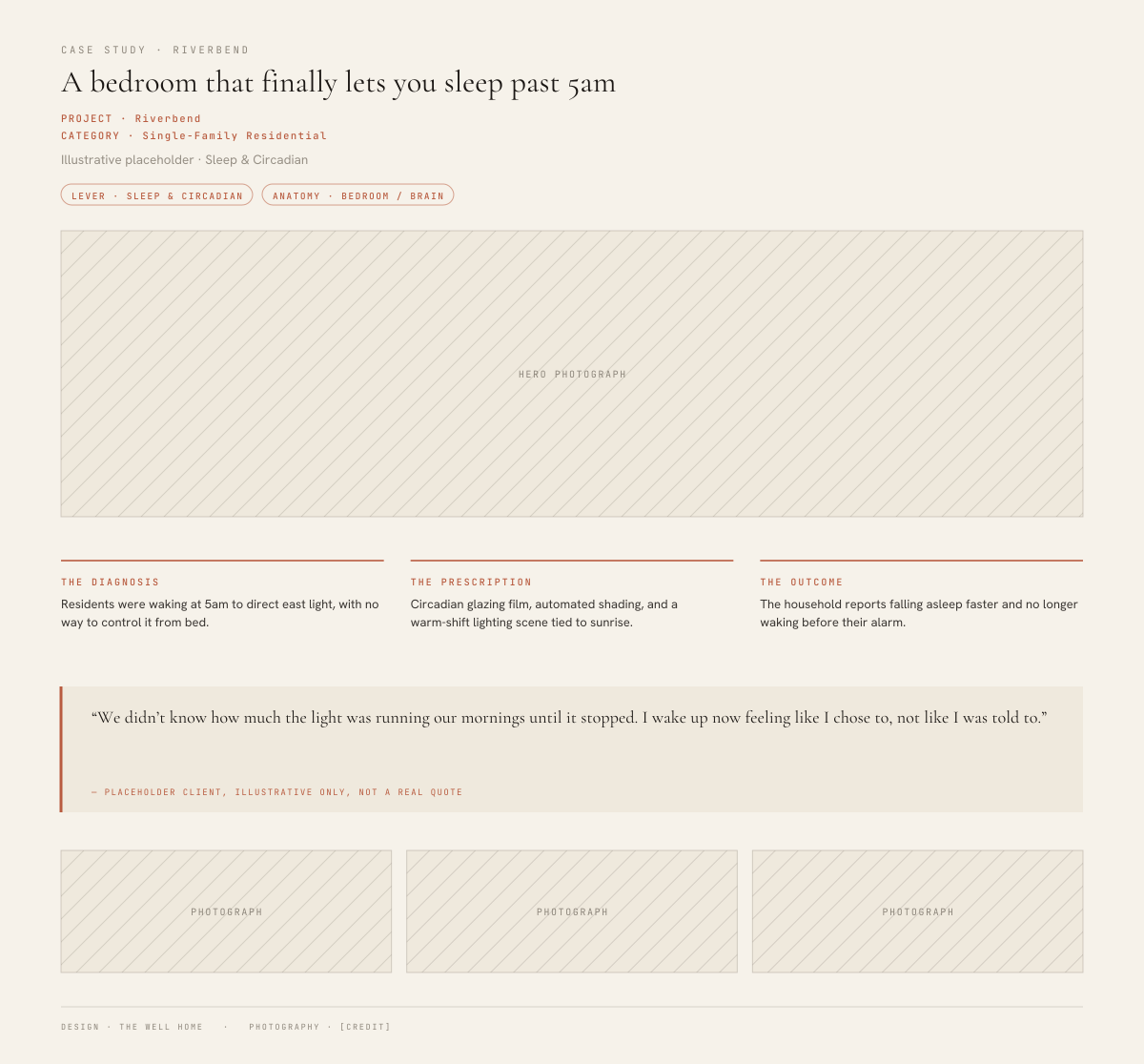
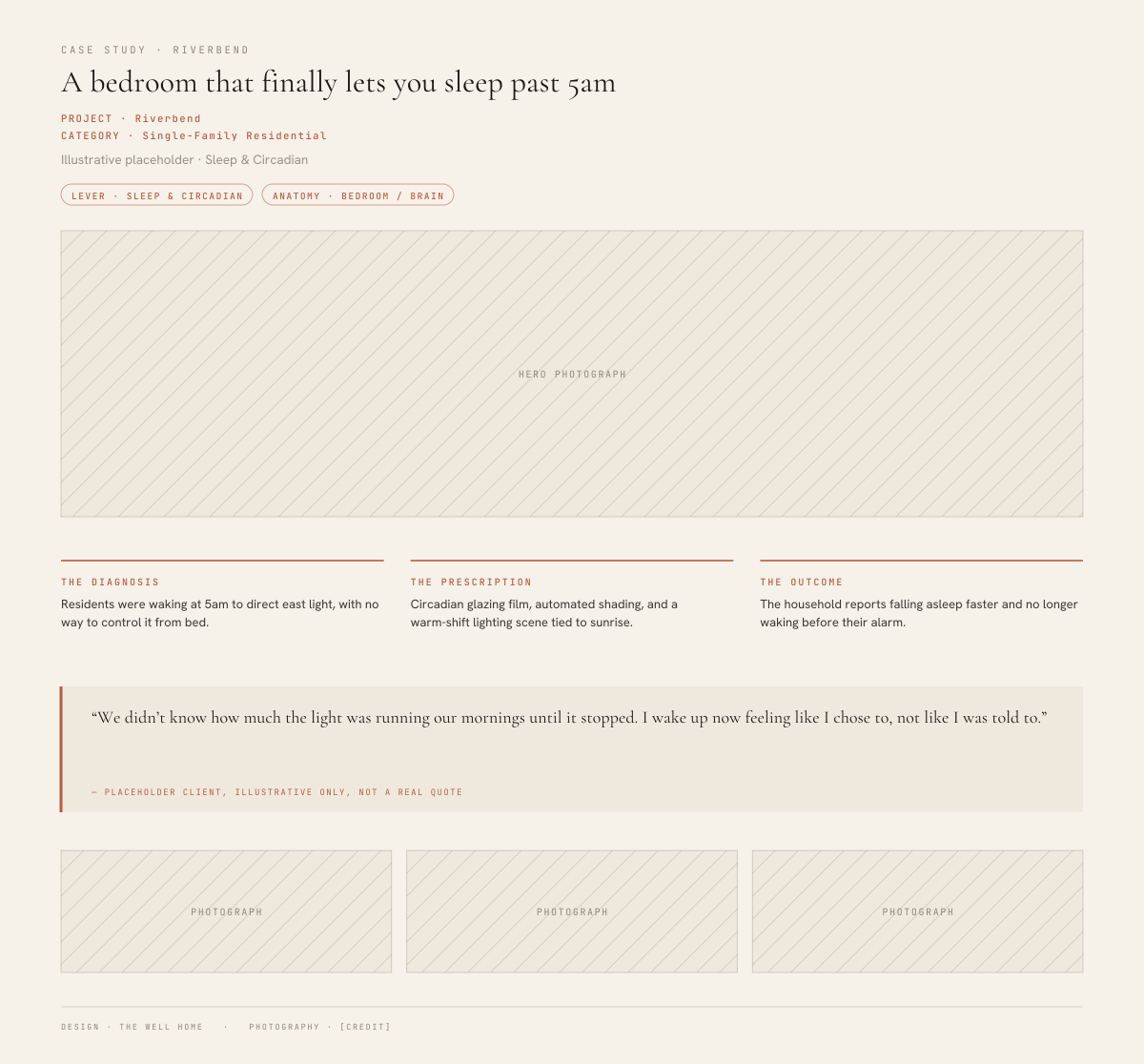
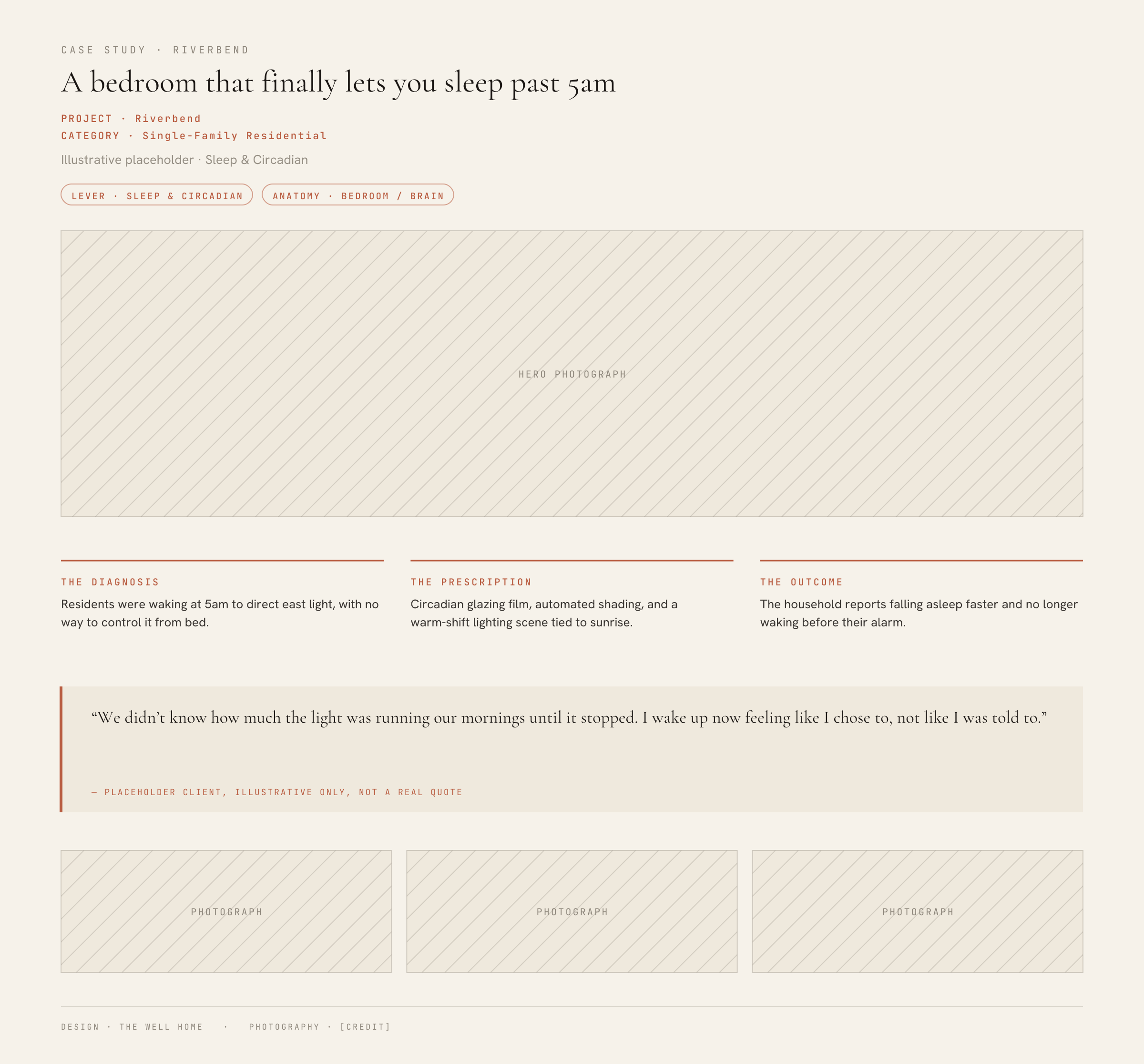
Residents were waking at 5am to direct east light, with no way to control it from bed.
The open kitchen put every cooking smell and sound into the room where the household tried to unwind.
The Prescription
The specific intervention, named plainly, tied to the Lever and the Anatomy system it treats. This is where the doctor-designer bridge does its work.
Circadian glazing film, automated shading, and a warm-shift lighting scene tied to sunrise.
A working kitchen closed off from the living room by a pocket door, ventilated independently.
The Outcome
A real, observed or reported outcome. Qualitative by default, since most projects will not have a measured number, and a household's own words are evidence, not decoration.
The household reports falling asleep faster and no longer waking before their alarm.
The family now eats dinner together most nights, which they say they had stopped doing.
Outcomes & Testimonials
The outcome is usually qualitative
Default to qualitative. “The household sleeps better” is a real outcome if it is what they told you; “31 percent improvement in sleep quality” is not a real outcome unless something actually measured a 31 percent improvement in sleep quality. If a number exists, source it exactly like the Stat Pack: state where it came from and how confident it is. If no number exists, do not manufacture one to fill the slot. A specific, well-observed sentence outperforms a vague statistic anyway.
The testimonial rule
Every case study should carry a testimonial where one exists. A testimonial is a direct quote from the household, attributed, used with their permission. It is not a paraphrase, not a composite of several conversations, and never a line written in their voice on their behalf. If a client has not given a quotable line yet, the block is left out or marked pending, not filled with an invented one. Get permission before anything is published, and confirm how they want to be identified: first name, initials, or anonymous. A verbal confirmation or an email is sufficient; no separate release form is required.
The Template
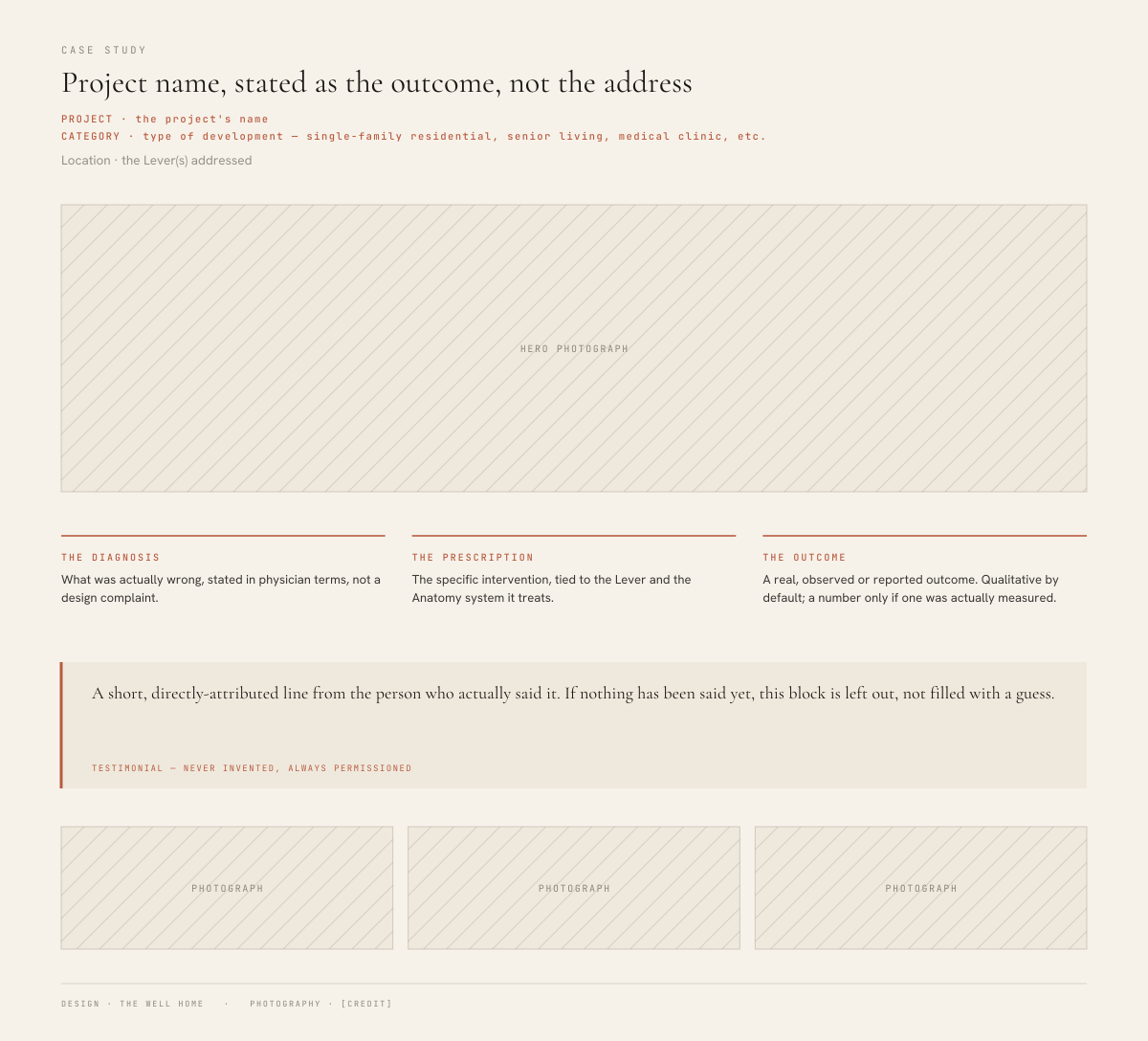
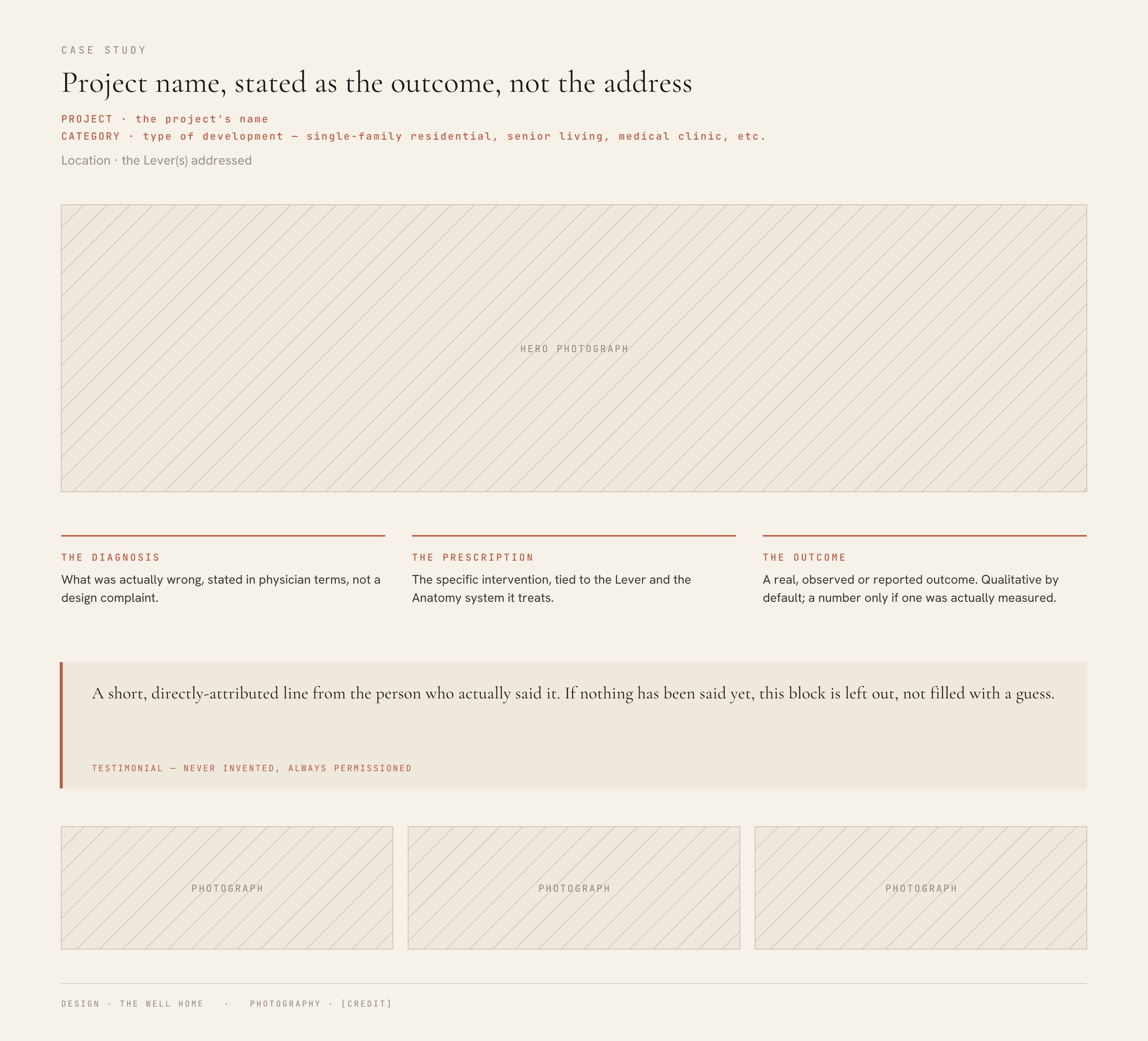
The page anatomy, in order.
| Element | Guidance |
|---|---|
| Eyebrow | “CASE STUDY” plus the project name, mono, wide-tracked. |
| Title | The outcome, not the address. “A bedroom that finally lets you sleep past 5am,” not “The Smith Residence.” |
| Project | The project name, stated plainly as its own labelled line. Required on every case study, even one already named in the Eyebrow. |
| Category | The type of development, in plain terms: a single-family residence, a senior living development, a medical clinic, and so on. Required on every case study, so the collection can be filtered by building type the same way it is filtered by Lever. |
| Subline | Location (city and state is enough) and the Lever(s) addressed. |
| Lever & Anatomy tags | Small chips naming which of the Seven Levers and which Anatomy system the project treated. |
| Hero photograph | One image, full width. The space after, not the render before. |
| The Diagnosis / Prescription / Outcome | Three ruled columns or stacked blocks, in that order, every time. |
| Testimonial | A direct, permissioned quote, or omitted entirely. Never invented. |
| Photo gallery | Three to six supporting images. Follows the Imagery direction and treatment rules. |
| Credit line | Design credit and photography credit, every time a photographer is owed one. |
Rules
- Diagnosis, Prescription, Outcome, in that order, every time. The order is the argument.
- Lead the title with the outcome, not the address or the square footage.
- State the Project name and its Category (the type of development) as their own labelled lines on every case study. Required, not optional, even when the project name also appears in the Eyebrow.
- Tag every case study to at least one Lever so the collection can be filtered and cross-referenced.
- Default every outcome to qualitative language. Only publish a number that was actually measured, sourced the way the Stat Pack sources one.
- Never write a testimonial on a client's behalf, even a flattering one. Quote them or leave the block out.
- Get written permission before publishing a client's name, likeness, or address. Anonymise on request.
- Photography follows the same direction and treatment rules as the rest of the brand. No exception for 'the client's own photos.'
- A case study with a strong diagnosis and prescription is still worth publishing with no measured outcome and no testimonial yet. Do not force either one to look finished before it is.
The template
Shown twice: once annotated as a teaching tool, once worked all the way through with the same Riverbend placeholder used for the Case Study slide in Presentations.